
The sea heals you (the tip of the dick)
Let’s face it, how much less nonsense would we get up to and spout if we were in the middle of a storm at sea? You might say: “I cause less damage on land.” Oh really? What about Trump, then? And Renzi, Salvini, Di Maio, Macron, Merkel, and so on? In short, it’s a proven fact that the worst nonsense happens on dry land, and Captain Schettino is no exception, because he was having a shag – which is perfectly healthy – whilst Costa Cruises back on dry land were ordering: ‘Sail 150 metres from the coast to give us some publicity so we can make more money; otherwise, you’ll end up as captains on a Lake Como ferry when it’s foggy – which is to say, all the time’. But do you really think that whilst having a shag, someone would say: “Darling, let’s get closer to the rocks – it turns me on more.”
In a nutshell: the body doesn’t lie, as Lowen used to say; try pondering the grand schemes of the universe and you’ll miss a ‘strambata’ (when the ‘rear’ sail, whose base is a spar or boom, suddenly swings from one side of the boat to the other); from thinking about the budget bill, you’ll find yourself back at Archimedes’ principle: ‘a body immersed in a liquid after a ‘bomata’ receives a wreath of flowers’ – full stop. It’s as if Valentino Rossi, during a Grand Prix, were to pause and think about the manual for the perfect motorcyclist; he’d only have time to recall the manual for the perfect idiot before being reduced to dust; he mustn’t think whilst racing, but feel the body’s receptors telling him which way to shift his arse to avoid falling over – full stop.
I don’t want to be trite and say that thinking is bad for you, but more simply that the ruin of the world from any point of view – be it mental health, material survival, the pollution and cancer we’re destined for, the economic resources concentrated in the hands of four power-hungry wankers, the lack of a future for the younger generations, etc., is due to the activity of thought, conditioned by a sick psyche that seeks to resolve purely psychological-depressive issues through external control – that is, by trying to compensate (not to avoid suffering, but in reality by meticulously planning everyone’s downfall) for this emotional vacuum by gorging on social media, unbridled consumerism, image, money, etc., which cause immense damage because it is as if someone whose engine won’t start were to search the passenger compartment for every possible combination of buttons that might get the car going again; if you don’t open the bonnet, you can devise the most sophisticated mathematical models based on the variables of the buttons, but you’ll remain stuck there until you die on paper – in reality, you were already dead at the age of 20.
The most conclusive proof and the clearest evidence of this is the latest report contained in the WWF’s annual report on biodiversity, the Living Planet Report 2018, prepared by a panel of 50 experts in collaboration with the Zoological Society of London: “Overexploitation and alterations to natural habitats, climate change, pollution, invasive species, dams and mines. All human actions that have had a devastating effect on nature. And on wildlife too, because between 1970 and 2014, 60 per cent of the Earth’s animals were wiped out.”
What’s the connection? It all stems from a perverse way of thinking on the part of humans, which is all the more perverse the more unconsciously they dig their own grave whilst thinking they are improving their quality of life and their survival on planet Earth. Animals do not think; they act on pure instinct and would never dream of interfering with the environment on which their survival depends. Of course, animals are succumbing precisely because they do not rationalise; they cannot concoct one piece of nonsense after another and die as a result. They cannot defend themselves against madness; paradoxically, they would need to possess our own analytical madness within them to fight us and remain ‘sane’. Either you’re sane or you’re a fool, and a fool destroys both themselves and others.
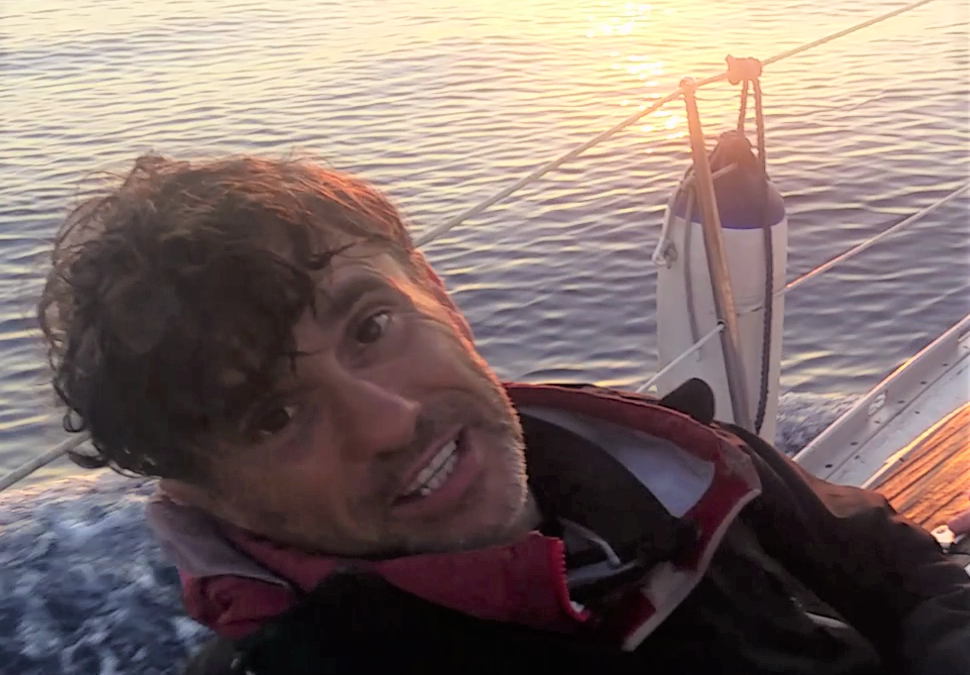
You’ll have realised what a sailing boat is for – a motorboat is already a step down; to enjoy and preserve nature, you end up polluting it with petrol, through the production cycle that builds it using self-polluting cars, and so on. – to heal us by switching off our minds; if you set off on a journey using nature’s resources (the wind, fish, rainwater, etc.), you can’t think nonsense because you’ll cause disasters; there are no thoughts, just actions in response to the signals the sea sends you, and you must respond to it in the right way (if it’s not right, the sea will make you realise it); it is nature that takes the lead and you don’t think, but you work hard following its prompts, not the other way round as happens on land, and if you get distracted by thinking and don’t listen to what the sea and the sky are telling you, you’ll find yourself hanging from a halyard (a rope used to hoist things up, but don’t use it as natural Viagra – it doesn’t work).
Even in my experience as a ‘Psycho-clod’, you have to be careful with your thoughts, because even as the editor of ‘Psicognagnole’ you mustn’t dwell on the books and manuals you’ve studied; otherwise, you’ll end up as a great thinker and practitioner of neurotic theories, and you’ll lose sight of what’s happening to the patient right in front of you, just like the sailor who concentrates on checking whether a sail is catching the wind perfectly and fails to see that he’s heading straight for an anchored oil tanker, with a waterspout approaching, a leak below deck, a bolt of lightning striking the mast, the rocks, the anchor dragging along with the fishing line and his wife, and so on. Proof of this is that if psychotherapy had observed what is happening in the real world rather than in paragraph 23, chapter three of the book: ‘Multidisciplinary application of comparative therapeutic techniques to this rubbish’ (don’t bother looking for it – it doesn’t exist), perhaps it would have helped to create a humanity more grounded in reality than on Instagram.
Even my sailing experience, full of grand titles to boast about and feed my ego, can be dangerous, because on a boat I might constantly be thinking about ‘what to do in the event of’ – based on the story of someone who drowned in a harbour – and if, at my age, I’m still alive, perhaps I should be more grateful for the little boat I had on the lake when I was four – and, knowing absolutely nothing about it, I began to sense the rules and actions it required of me to move. Luckily for me, before I got my ‘paper qualifications’, I worked my fingers to the bone on the various old tubs I’ve had out on the seas, having never read a thing, but with all my senses alert to listen to what the sea or the sky was saying before I did something daft.
Every time I’ve taken people out, whether groups of patients or simply holidaymakers, I’ve learnt to gauge just how far up someone’s arse they’ve got their head. Imagine having someone on board who suffers from panic attacks, and you – the pompous ‘Captain’ and ‘Psychologist’ to boot – failing to sense, like an animal with its young, what the tolerable limit of stress is, or rather, of ‘distancing oneself from false earthly certainties’; never force the issue, yet it is the only way to bring people back to their senses.
To conclude, I personally believe that modern society has strayed too far, in both mind and body, from that animal wisdom that lies within us. Let us not forget that we are primates, the most evolved form, yet beneath the ‘social façade’ we act in exactly the same way as they do; the only difference is that our behaviour becomes harmful because – thanks to, or perhaps due to the misfortune of, our cerebral cortex – we can build weapons, nuclear power stations, and dominate millions of people – something impossible, and thankfully so, for a lower animal, which would, however, live in a clean world that renews itself without irreversible processes such as climate change caused by us humans.
Obviously, it’s too late for everything – and it’s not just me saying this, but the data – but if we at least want to die without an oxygen mask in a self-driving electric car (which is only superficially eco-friendly, as the electric production cycle uses just 10 per cent renewable energy) or chat to the greengrocer via Facebook, we need to give our senses back some space and put away the little ‘fuck-all’ minds we’ve become.
Nothing brings you back to yourself quite like a sailing boat, because every time you get carried away with your own ramblings – thinking, rather than ‘listening and feeling’ what the sea, the sky and the wind are saying – that gentle breeze turns into a fart that capsizes you; that’ll teach you not to listen to it, you idiot.